Join us for the inaugural International Conference on Sustainable Chemistry for Net Zero
Taking place at the University of St Andrews in Scotland, this conference will focus on the pivotal role chemistry has to play in delivering a net zero future for all.
A stellar line-up of international keynote and plenary speakers will discuss various topics in sustainable chemistry. There will be opportunities to submit oral and poster abstracts – details coming soon!
Put the date in your diary: 10-13 June, 2025
Organisers
ScotChem is very grateful to the following individuals for the organisation of the conference:
Co-chairs
Prof. David Cole Hamilton (University of St Andrews)
Dr. Amit Kumar (University of St Andrews)
International advisory committee
Prof. Helen Sneddon (Green Chemistry Centre of Excellence, University of York)
Dr. Thomas Schaub (BASF, Germany)
Prof. C. J. Li (Department of Chemistry, McGill University, Canada)
Dr. Alessandra Quadrelli (Institut de recherches sur la catalyse et l’environnement, France)
Prof. Cristina Pozo-Gonzalo (Instit for Frontier Materials, Deakin University, Australia)
Prof. Sun Zhenyu (College of Chemical Engineering, Beijing University of Chemical Technology, China)
The agenda includes plenary speakers from academia and industry, a panel discussion and opportunities to deliver oral and poster presentations. Further details will be published shortly.
There will be a poster and talk prize for first place and runner up, sponsored by Dalton Transactions.
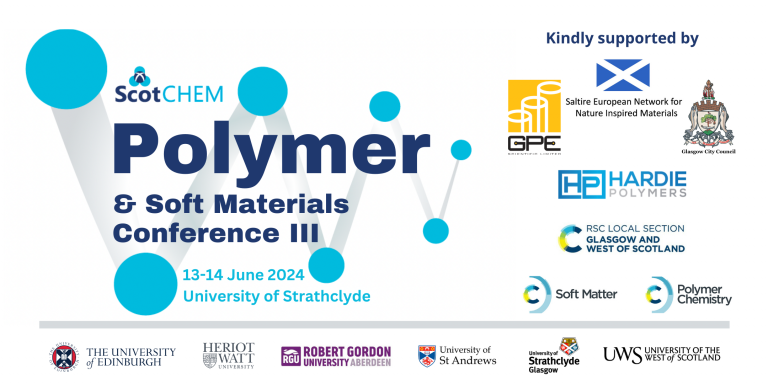
The University of Strathclyde is hosting the third ScotCHEM Polymer & Soft Materials Conference, an annual fixture in Scotland’s chemistry research calendar. The conference series covers all areas of related research including polymer chemistry and technology, self-assembly, biointerfaces, and bioinspired and advanced materials. This year, we are expanding to a 2-day event and further aiming to highlight sustainability research, from best lab practices to degradable polymers and upcycling approaches.
The programme will include invited and contributed talks, poster sessions, and other networking and discussion opportunities. A highlight will be a Civic Reception hosted by the Lord Provost and Glasgow City Council, with complimentary drinks at the prestigious Glasgow City Chambers on Thursday evening, 13 June.
Abstract submission
Submissions are open to contributions:
Scientific oral and poster presentations.
Flash oral presentations highlighting your laboratory’s sustainability best practices (from day-to-day operations to the impact of sustainability awards and certifications).
Submission deadlines
Oral and Poster (scientific and sustainability): 1 May 2024. Successful oral submissions will be notified by 10 May 2024.
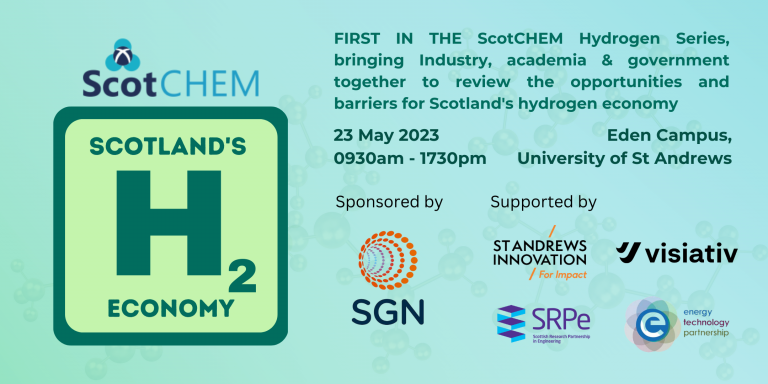
First in the ScotCHEM Hydrogen series, bringing together industry, researchers and policymakers to identify opportunities to grow Scotland’s Hydrogen Economy.
Meeting, Tuesday, 23 May, University of St Andrews, Eden Campus, Guardbridge.
The annual ScotCHEM Polymer and Soft Materials Conference, in partnership with the University of Edinburgh School of Chemistry.
Industry Keynote Speaker:
Dr Paul Hunt ‘Practicality of Making Sustainable Polymers’ – Croda International
Research keynote speakers:
Dr Amit Kumar ‘Homogeneous (De)hydrogenative Catalysis for A Circular Economy’ – University of St Andrews
Dr Ruaraidh McIntosh ‘Balancing Sustainability with Activity in Polymerisation Catalysis’ – Heriot Watt University
Dr Emily Draper ‘Using Supramolecular Assembly for Flexible Organic Materials’ – University of Glasgow
Prof Mike Ingleson ‘Electrophilic borylation as a route to generate deep LUMO / near IR-emitting small molecules and polymers’ - University of Edinburgh
Dr Ketan Pancholi ‘Magnetic Polymer Nanocomposites Incorporating Metal-Organic Frameworks: Tailored Synthesis for Targeted Applications’ – Robert Gordon University
Dr Ross Minty ‘The role of residual stress at the fibre-matrix interface in composite materials’ – University of Strathclyde
Bringing together theoretically orientated chemists since 2006.
29-30 August - Python training and networking
Organiser: Professor Carole Morrison
Monday 29 August Python training day
Fully booked!
This course is aimed at programmers with little or no Python knowledge seeking to learn how to use Python for scientific computing.
We will introduce Python’s fundamental scientific libraries numpy and matplotlib. Participants should already have some basic knowledge of the Python language.
Participants should also be comfortable with using the bash shell. For an introduction to the shell, please see, for example, Software Carpentry’s lessons on Unix Shell.
We strongly recommend you download, before the course, Anaconda Python Version 3.9 . This has all the packages required (and more).
Python Training Outline Programme:
10.00 – Registration and check installations10.15 – Introduction 11:15 – Break 11:30 – Using numpy 13:00 – Lunch 14:00 – Using matplotlib 15:30 – Break 15:45 – Exercises 17:00 – Close
Tuesday 30 August Network Day
Registrations closed.
Back after a break due to COVID, the ScotCHEM Computational Chemistry Symposium will provide a mixture of talks and poster sessions, bringing together Scotland’s computational chemistry community.
Organiser: Prof Carole Morrison, Univerity of Edinburgh
POSTER SUBMISSION: CLOSED
Network Day Programme
10:00 – Registration and poster set-up
Session I
10:25 - 10.30 – Welcome and announcements
10.30 - 11.00 – Dr Tahereh Nematiaram, University of Strathclyde, ‘Organic Electronics from Structural Databases: Discovery and Design of Multifunctional Materials’
11.00 - 11.30 – Oliver Lee, St. Andrews University, ‘Silico – A toolkit for simplifying the computational chemistry pipeline’
11.30 - 12.00 –Dr Hessam Mehr, University of Glasgow, ‘Probablistic reasoning: From interpreting known chemistry to discovering the unknown’.
12.00 - 1.30 Lunch and posters
Session II
1.30 - 2.00 – Dr Rob Arbon, University of Edinburgh, ‘Efficient and robust optimisation of models of protein conformational dynamics’
2.00 - 2.30 – Dr. Andrew Prentice, Heriot Watt University, ‘Modular approaches to compact configuration interaction wavefunctions’
2.30 - 2.50 – Flash poster presentations
2.50 - 3.20 – Dr Maria Jose Aliaga, University of Glasgow, ‘Metal oxide chemistry, self-assembly and applications’
3.20 - 3.50 – Prof. Michael Buehl, University of St. Andrews 'pNMR shifts of MOFS from DFT'
3.50 - Closing remarks/opening of poster session/cheese and wine reception
The Plenary Speaker is Prof. Adrian Roitberg, University of Florida and his talk will be “Is Quantum Chemistry Amenable for Machine Learning? Are the Computers Coming for Our Jobs?"
Programme
Session 1
09:50—10:00 Welcome and opening remarks
10:00—10:30 Dr James McDonagh, IBM Research Group, "Parameterization and automation of coarse-grained simulations for industrial chemical formulation".
10:30—11:00 Dr Laia Vila-Nadal, University of Glasgow, "POMzites a roadmap for inverse design in metal oxide chemistry".
11:00—11:30 Jonathan Colburn, University of St Andrews, "Quantifying Electrostatic Preorganisation in Heme Peroxidase Enzymes with QM/MM".
11:30—12:00 Arron Burnage, Heriot-Watt University, "Mechanistic Study of the Room Temperature Acceptorless Dehydrogenation of an Isobutane σ-Complex in the Solid-State".
12:00—13:00 Lunch
Session 2
13:00—13:30 Dr Oliver Henrich, University of Strathclyde, "Coarse-Grained Modelling of DNA-Based Hydrogels and DNA Supercoiling". 13:30—14:00 Dr Daniel Dawson, University of St Andrews, "Computational Insights into the Extensively Disordered GaPO-34A Structure". 14:00—14:30 Dr Xiang Sheng, Stockholm University, "Modeling Enzymatic Enantioselectivity using Quantum Chemical Methodology". 14:30—15:00 Dr Rafel Szabla, University of Edinburgh, "Modelling reactions involving UV-induced electron transfer in DNA".
15:00—15:30 Break
Session 3
Plenary Speaker
15:30—16:30 Prof Adrian Roitberg, University of Florida, "Is Quantum Chemistry Amenable for Machine Learning? Are the Computers Coming for Our Jobs?"